




You don’t buy exclusive sneakers the same way you buy a standard pair. With limited releases, popular collabs, and in-demand models, scarcity, sizing, authenticity, and timing play a much bigger role. That’s why a good purchase doesn’t start with hype, but with proper preparation. It helps you avoid overpaying, ending up with the wrong size, or buying a pair that doesn’t meet your expectations.
Whether you’re looking at an Air Jordan 1, ASICS GEL-NYC, GEL-Kayano 14, New Balance 9060, Yeezys, or another limited sneaker, the right approach helps you make a smarter choice. Below, you’ll find the most important buying tips for exclusive sneakers, explained clearly and made practical.
Explore Our Collection
Shop Now →Know exactly which exclusive sneakers you want beforehand
The best buying decisions happen when you already know clearly what you want to buy. Many buyers start too broad and let themselves be guided by whatever is trending at the moment. That increases the risk of impulse purchases, unnecessarily high resell prices, and disappointment afterward.
So first look at the model, colorway, intended use, and your budget. Not every exclusive sneaker is equally wearable for daily use. Some models are loved mainly for their story or rarity, while others are popular because of comfort and styling versatility.
- Model: choose for example between lifestyle, retro basketball, or runner style
- Use: do you want to wear them daily or mainly keep them as a collector’s pair?
- Color: do you want something versatile or more eye-catching?
- Budget: set your maximum price in advance, including any possible resell premium
- Size: check whether the model fits true to size or runs smaller/larger
If you’re clear on this in advance, you’ll buy more deliberately and be less likely to go for the first available option.
Always check authenticity
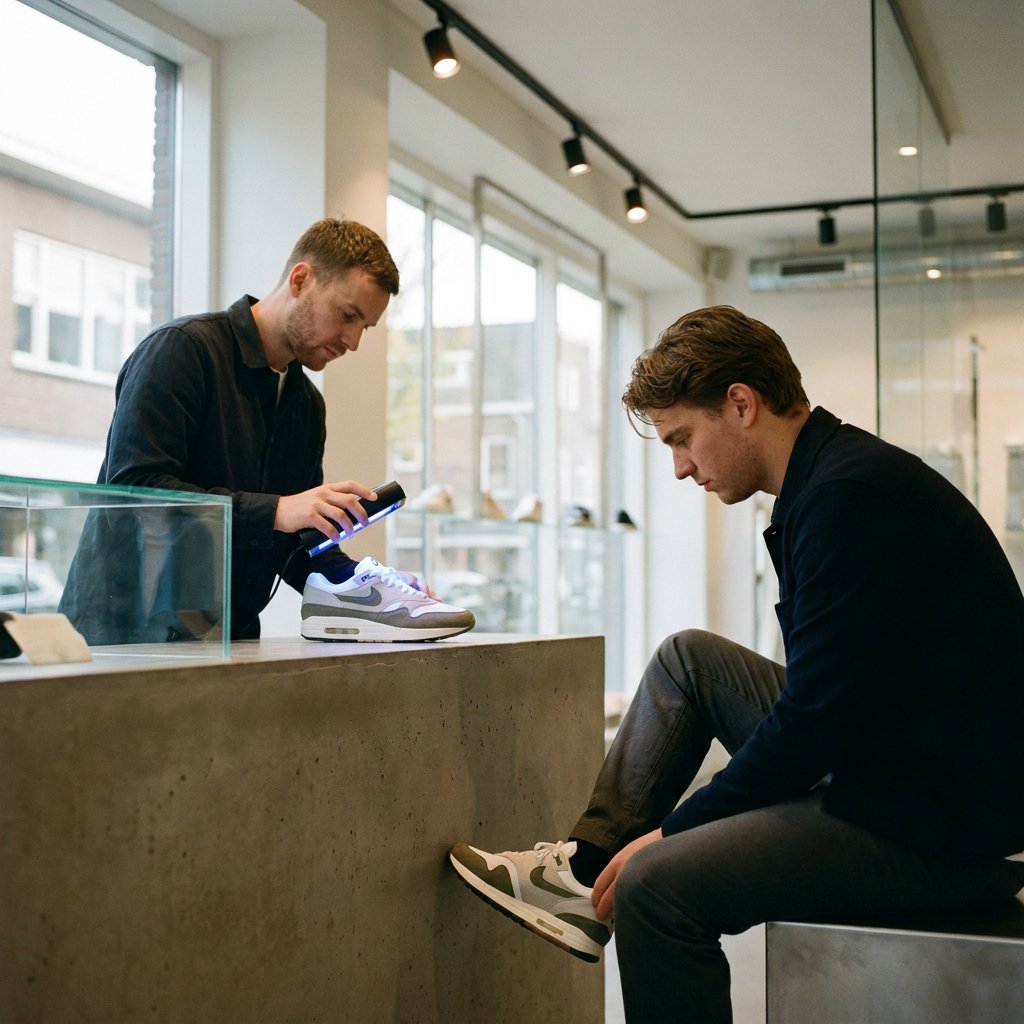
One of the most important buying tips for exclusive sneakers is checking authenticity. Popular models are often copied. The more desirable the release, the greater the chance that replicas appear on the market. Especially with sneakers that are sold out everywhere, you need to be extra critical.
Don’t focus on just one detail. Look at the full picture. An authentic sneaker is usually recognizable by consistent finishing, correct labels, proper product codes, and materials that match the original model.
What to look for during an authenticity check
- The product code on the shoe and box should match
- The box label should match the brand, model, color, and size
- Stitching, logos, and shape should be clean and consistent
- Materials should feel the way you would expect for that model
- Packaging, extra laces, and accessories should make sense for that release
- A suspiciously low price is often a warning sign
If in doubt, compare the sneaker with official product photos and known references for that model. Especially with exclusive sneakers from Nike, Jordans, ASICS, and New Balance, small differences can reveal a lot. Also read how to spot real Nike and adidas sneakers if you want to pay closer attention to authenticity signals.
Only buy from reliable sellers
The seller is almost as important as the sneaker itself. A good offer means little if the origin is unclear, communication stays vague, or return conditions are unfavorable. Reliable sellers are transparent about authenticity, delivery time, product condition, and sizing information.
So look beyond price alone. A slightly higher price from a reliable seller is often smarter than a deal that seems great but carries a lot of risk. Especially with resell or rare drops, you’re not just paying for the product, but for certainty too.
Checklist for evaluating a seller
- Clear product descriptions and photos
- Clear information about authenticity checks
- Transparency about delivery time and return policy
- Reachable customer service for questions about size or model
- Consistent communication about stock and availability
At HypedPair, this matches what buyers look for: exclusive sneakers with a focus on authenticity, sizing advice, and practical buying information. That matters most for models that sell out fast or are difficult to find again later.
Pay close attention to sizing and fit by model
The wrong size is one of the most common mistakes when buying exclusive sneakers. That’s because sizing differs a lot by brand and sometimes even by model. An Air Jordan 1 may fit differently from a New Balance 9060, while an ASICS GEL-Kayano 14 has a different fit from a GEL-NYC.
So don’t rely blindly on your standard shoe size. Always check model-specific sizing information. Especially if returns are difficult or you’re buying through resell, sizing advice becomes even more important.
Practical tips for choosing the right size
- Measure your feet at the end of the day for a more realistic result
- Compare the internal length in centimeters if available
- Check whether the model fits narrow, wide, or true to size
- Consider your use case: casual wear may require a different fit than extended walking
- Check whether you wear thicker or thinner socks with this type of sneaker
For sought-after models, it’s worth looking up sizing advice in a knowledge base or through customer service beforehand. That helps prevent you from securing an exclusive pair that ends up not working for you.
If you’re unsure about this model, check the Air Jordan 1 size guide. For New Balance, you can find more specific advice in the New Balance size chart and fit guide. If you’re buying one of the most hyped models, also check: How do Nike Dunk fit?
Follow releases and raffles in time
If you want to buy exclusive sneakers at retail price, you need to follow release information actively. Many limited editions are sold through specific release dates, raffles, or first come, first served drops. If you only start looking on release day, you’re usually too late.
Good preparation significantly increases your chances. Set up accounts early, save your address details, and follow official channels from brands and selected retailers. It’s also smart to keep European and UK drop times in mind, since releases don’t always go live everywhere at the same moment.
How to improve your chances on limited releases
- Sign up for raffles in advance
- Follow official release calendars and retailers
- Make sure your account, payment method, and address details are ready
- Use multiple reliable release sources to verify times
- Don’t wait until the last moment to log in or confirm
This is especially relevant for sneakers that are trending now or have a strong collab background. With those releases, speed is often just as important as budget.
Understand the difference between retail and resell
Not every exclusive sneaker is still available at retail. Once a release sells out, the market often shifts to resell. That means you pay a price determined by demand, supply, size popularity, and the hype around the model. If you understand that difference, you’ll buy more rationally and avoid entering at the peak.
Retail is the original selling price at release. Resell is the market price afterward. For popular sizes and rare colorways, that difference can rise sharply. That doesn’t automatically mean resell is a bad option, but it does mean you should buy more selectively.
When resell can make sense
- If the model is completely sold out and you genuinely want to wear it
- If the price is stable instead of sharply peaking
- If it’s a timeless model with lasting popularity
- If you’re buying from a reliable seller with authenticity checks
Ask yourself whether you’re buying out of genuine preference or only because of fear of missing out. That distinction often makes the difference between a smart purchase and an expensive impulse buy.
Evaluate price, hype, and real value
Many buyers look for answers to questions like: which sneakers will go up in value, what are the best sneakers, and which sneakers are trending right now? Those are understandable questions, but they can also lead you toward the wrong focus. A sneaker that’s popular on social media is not automatically a good buy for you.
So focus on three things: wearability, scarcity, and price development. An exclusive sneaker has more value when the model is widely loved, production numbers are limited, and the colorway remains interesting over time. Still, future value is never guaranteed.
So don’t buy based only on investment expectations. For most buyers, the best sneaker is still the pair you genuinely want to wear, that fits well, and that you buy at a fair price.
Check the condition if the pair is not deadstock
Not every exclusive sneaker is sold brand new. With some models, you’ll come across worn or tried-on pairs. In that case, you need to look much more carefully at the condition of the sneaker, because small signs of wear can have a big effect on both value and enjoyment.
- Check outsole wear and heel drag
- Look for creasing in the toebox
- Inspect discoloration, damage, and odor
- Check whether the original box and accessories are included
- Ask for clear photos from all critical angles
If the condition is not clearly described, the risk of disappointment is higher. Always ask more questions before buying.
Also think about maintenance and value retention
Good buying tips for exclusive sneakers don’t stop after checkout. Especially with light materials, suede panels, or mesh runners, maintenance matters. If you keep an exclusive pair in good condition, you’ll enjoy it longer and preserve more value.
Store sneakers in a dry place, avoid unnecessarily bad weather, and use cleaning products that match the material. Preferably keep the box, extra laces, and accessories too. That’s not only practical, but also relevant if you later want to sell or trade the pair.
What if your sneaker is out of stock?
With exclusive sneakers, it often happens that your exact size or desired colorway is not immediately available. In that case, it’s smart to look beyond the standard product page. Some specialized sellers can help find an exclusive pair through a sneaker request.
That’s especially useful if you’re looking for a specific model, such as a hard-to-find Air Jordan 1, a popular New Balance 9060, or a sought-after ASICS release. It helps you avoid moving to unclear marketplaces without verification. If you want to view more exclusive models right away, you can also check the special items.
Frequently asked questions about buying exclusive sneakers
Which sneakers will go up in value?
That varies by release, but it usually involves limited editions, strong collabs, and iconic models with lasting demand. Think of certain Jordans, rare Nike releases, or sought-after colorways from ASICS and New Balance. Still, value growth remains unpredictable, so don’t buy with profit alone in mind.
What are the best sneakers to buy?
The best sneakers are not the same for everyone. Look at fit, style, comfort, intended use, and price. For one person, that may be a timeless Air Force 1 or Air Jordan 1; for another, a comfortable runner like the ASICS GEL-Kayano 14 or New Balance 9060.
Which sneakers are trending right now?
In 2026, retro basketball models, technical runners, and strong collabs remain popular. Models from Nike, Jordans, ASICS, and New Balance are performing especially well. But being trendy matters less than whether a model suits your style and how you want to use it.
How do I know if an exclusive sneaker is the right size?
Always check model-specific sizing advice. Don’t only look at your usual size, but also at fit, foot width, and experiences with that exact model. If you’re in doubt, extra sizing advice is the safest option.
Is buying resell always more expensive than retail?
Yes, usually. After a release sells out, the price often rises because of scarcity. Sometimes the premium stays limited, but with popular sizes and hyped models, the difference can be significant.
What is the biggest mistake when buying exclusive sneakers?
The biggest mistake is buying without preparation. That includes skipping a size check, not evaluating the seller, being too late for releases, or blindly following hype. With a few targeted checks, you can avoid most bad purchases. If you also want to compare models more effectively, look up the differences between popular models before deciding.
This article was written by Marijn van der Heijden.

Leave a comment
This site is protected by hCaptcha and the hCaptcha Privacy Policy and Terms of Service apply.