




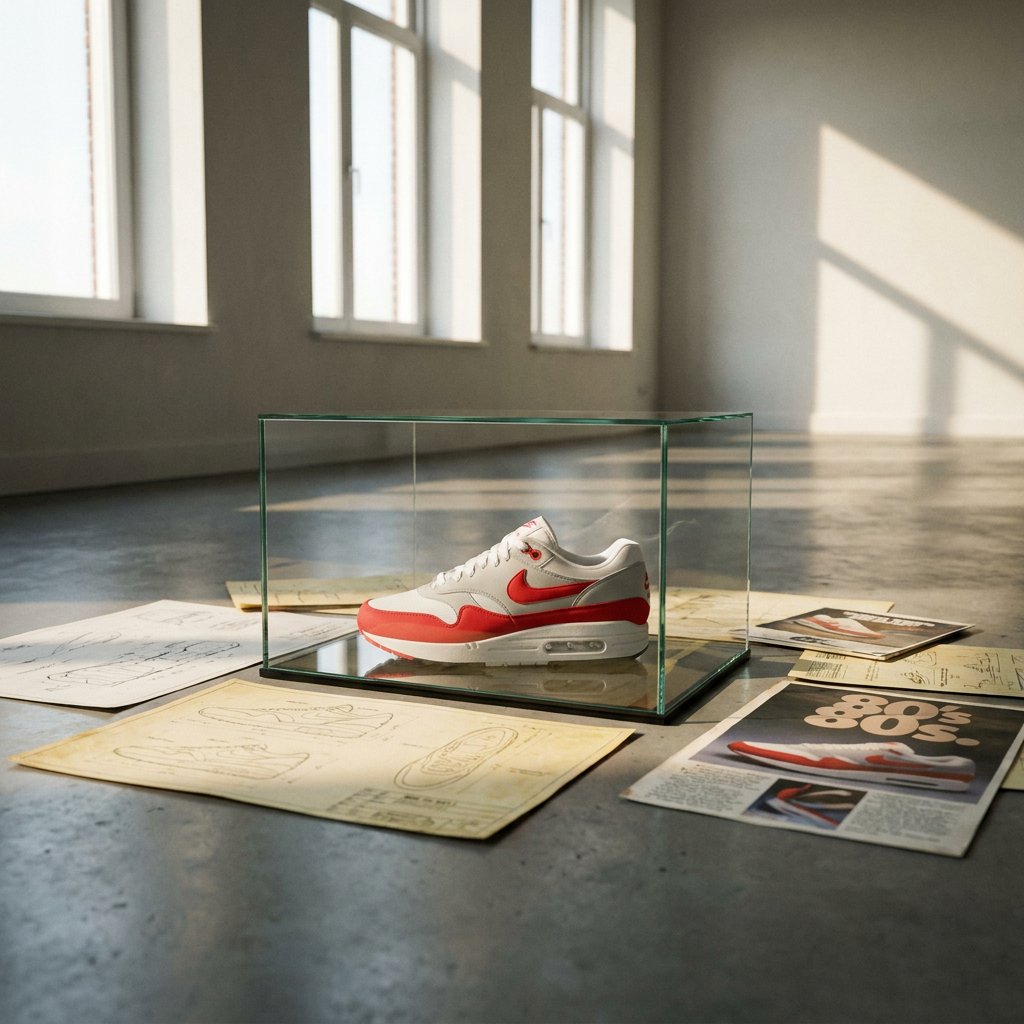
The history of Nike Air Max does not begin with a sneaker alone, but with an idea: making cushioning visible. What started with experimental Air technology grew into one of the most famous sneaker lines ever. The Nike Air Max 1 from 1987 in particular played a decisive role in that story. That model brought together technology, design, and culture in a way that permanently changed the sneaker world. So if you are looking into the history of Nike Air Max, you end up with a story about innovation, taking risks, and a design that was far ahead of its time.
Ontdek de nieuwste sneaker drops
Shop collectie →How Nike Air Max grew out of the first Air technology
To properly understand the history of Nike Air Max, you first need to go back to the foundations of Nike Air. That technology traces back to Marion Franklin Rudy, an aerospace engineer who developed a cushioning system using encapsulated air. The idea was simple but innovative: a sole that absorbs impact with air instead of foam alone.
At first, several companies saw little in the concept, but Nike recognized its potential. In 1978, the Nike Air Tailwind appeared as the first Nike model with Air technology. That was the first step, but for many consumers the technology still felt abstract. You could feel the cushioning, but you could not see what made the shoe technically special. That exact problem later became the starting point for Air Max.
What is the difference between Nike Air and Nike Air Max?
A common question in the history of Nike Air Max is the difference between Nike Air and Nike Air Max. Nike Air is the technology itself: an air-filled unit in the sole that provides cushioning. Air Max is the evolution of that concept, where the Air unit was made visible through a window in the midsole.
That difference may seem small, but it was hugely important commercially and visually. With regular Nike Air, you as the wearer knew there was technology in the shoe, but with Air Max everyone could see it instantly. As a result, cushioning became not only functional, but also part of the design. That visible element gave Nike a highly recognizable silhouette and laid the foundation for the line's massive popularity.
Tinker Hatfield's role in the history of Air Max
If there is one name that is essential in the history of Nike Air Max, it is Tinker Hatfield. He had a background in architecture and did not initially work as a traditional sneaker designer. That different perspective was exactly what made him so important. Hatfield thought not only in terms of performance, but also form, visibility, and experience.
In the 1980s, Nike was looking for renewal. Air technology was technically strong, but the brand wanted a model that made it clearer why that innovation mattered. Hatfield was given that challenge. His task was not only to design a good running shoe, but also to make the story of Air understandable to a broad audience. That made him the key figure behind the shift from invisible technology to iconic product design.
The inspiration from the Centre Pompidou in Paris
One of the best-known chapters in the history of Nike Air Max is the inspiration behind the design. Tinker Hatfield drew inspiration from the Centre Pompidou in Paris. That building stood out because technical components that normally stay hidden were deliberately placed on the outside for everyone to see.
Hatfield translated that idea into footwear design. Why hide advanced cushioning inside the sole when that very feature makes the product unique? By making the technology visible, the shoe became more honest in its design and stronger in its appearance. That architectural insight made the Air Max fundamentally different from earlier Nike models with Air.
Why the visible Air unit was so revolutionary
The visible Air unit was not just a style choice. It was an answer to a clear problem: consumers needed to understand what Air actually did. By placing a window in the sole, Nike made the technology tangible and credible. You no longer had to rely only on marketing, because you could literally see the cushioning.
At the time, that was strikingly bold. Inside Nike, there was doubt about the idea. A visible air bag was seen by some as too extreme. There were also questions about durability, production, and commercial viability. Still, Hatfield pushed forward. Precisely because the design was so different, Air Max later earned its iconic status. The model showed that technical innovation and recognizable design could work perfectly together.
From prototype to release: the first Nike Air Max 1
The first step toward the final Air Max 1 did not happen without problems. Early prototypes from 1986 had a larger visible Air unit, but that setup proved technically vulnerable. The sole construction had to be adjusted to make the model strong enough for a wide release.
That ultimately led to a more refined design, where the Air unit remained clearly visible while the shoe performed better in production and in use. On March 26, 1987, the Nike Air Max 1 was officially released. That moment is still seen as a key date in the history of Nike Air Max. Not only because a new model launched, but because Nike introduced a completely new design language with it.
What were the first Nike Air Max?
When people ask what the first Nike Air Max were, in practice they are almost always referring to the Air Max 1. That model was the first sneaker in the Air Max line and appeared in 1987. The best-known original versions are the OG red and blue colorways, which are still seen as classics today.
The Air Max 1 stood out because of its lightweight upper, sporty shape, and of course the window in the sole. That immediately set the shoe apart from many other runners of its time. Where earlier performance shoes mainly looked functional, the Air Max 1 combined sport, lifestyle, and visual innovation in one model.
Important moments in Nike Air Max history
- 1978 - Introduction of Nike Air in the Nike Air Tailwind
- 1987 - Release of the Nike Air Max 1 with visible Air unit
- March 26 - The date that later became Air Max Day
- 1990s - Further growth of the line with new Air Max models
- 2023 - Return of the Big Bubble as a reference to early prototypes
The growth of Air Max after 1987
After the release of the Air Max 1, Nike continued developing the formula. Visible cushioning became a recognizable hallmark of the line, but each new model gave it its own interpretation. In the years that followed, models such as the Air Max 90, Air Max 95, and Air Max 97 appeared, each raising the bar in its own way in terms of design and cushioning.
Because of that, Air Max became more than one successful sneaker. It became a family of models with its own place in sport and streetwear. While the Air Max 1 is mainly known as the start of the story, later releases showed how far the concept could be extended without losing its core.
Cultural impact of Nike Air Max
The history of Nike Air Max is not only technical or design-focused. The line also took on strong cultural meaning. Air Max grew from performance running into a permanent presence in street style. In the Netherlands, the shoe gained extra status because of its popularity within subcultures and the wider sneaker community.
That mix of comfort, recognizability, and bold shape is exactly what made Air Max so strong. You were not just wearing a sports shoe, but a model with history. That explains why certain colorways, retros, and collaborations keep attracting so much attention. For example, check out the Nike Air Max collection if you want to see different models within the line.
Air Max Day and the lasting legacy of the Air Max 1
Every year, March 26 is dedicated to Air Max Day, a date that directly refers to the release of the Air Max 1 in 1987. For Nike, it is the moment to bring back classics, launch new variations, and highlight the heritage of the line. For sneaker lovers, it is above all confirmation of how big Air Max's impact still is today.
The lasting appeal lies in the combination of story and shape. The Air Max 1 was not just the first in a series, but the model that made Nike's technology visible and culturally relevant. That is why the history of Nike Air Max is still relevant today, especially for anyone who wants not just to wear sneakers, but also to understand them. If you want to go deeper, you can also read about the difference between Air Max 1 and Air Max 90 or discover: How do Nike Air Max 1 fit?.
FAQ about the history of Nike Air Max
What is the history of Air Max shoes?
Air Max shoes grew out of Nike Air technology, which was already being used in 1978. The real breakthrough came in 1987 with the Air Max 1, the first model with a visible Air unit. From that moment on, Air Max grew into one of Nike's best-known sneaker lines.
What are the first Nike Air Max?
The first Nike Air Max is the Nike Air Max 1 from 1987. This model was the first sneaker in which the Air unit was made visible through a window in the sole.
What is the difference between Nike Air and Nike Air Max?
Nike Air is the cushioning technology itself. Air Max is the line in which that technology was made visible. The main difference is therefore that with Air Max, you can see the Air unit.
Who designed the Nike Air Max 1?
The Nike Air Max 1 was designed by Tinker Hatfield. His background in architecture played a major role in the final design.
What was the Air Max 1 inspired by?
The Air Max 1 was inspired by the Centre Pompidou in Paris. That building is known for its visible technical structure on the outside, an idea Hatfield translated into the visible Air unit.
Why is March 26 important for Air Max?
On March 26, 1987, the Air Max 1 was launched. That is why Air Max Day is celebrated every year on that date.
This article was written by Marijn van der Heijden.
★★★★★ 4.9/5 uit 400+ reviews
Scoor jouw volgende exclusive pair
Geverifieerd op echtheid, scherpe prijzen en snel verzonden. Ontdek de meest gewilde sneakers van dit moment.
Shop sneakers


Leave a comment
This site is protected by hCaptcha and the hCaptcha Privacy Policy and Terms of Service apply.