



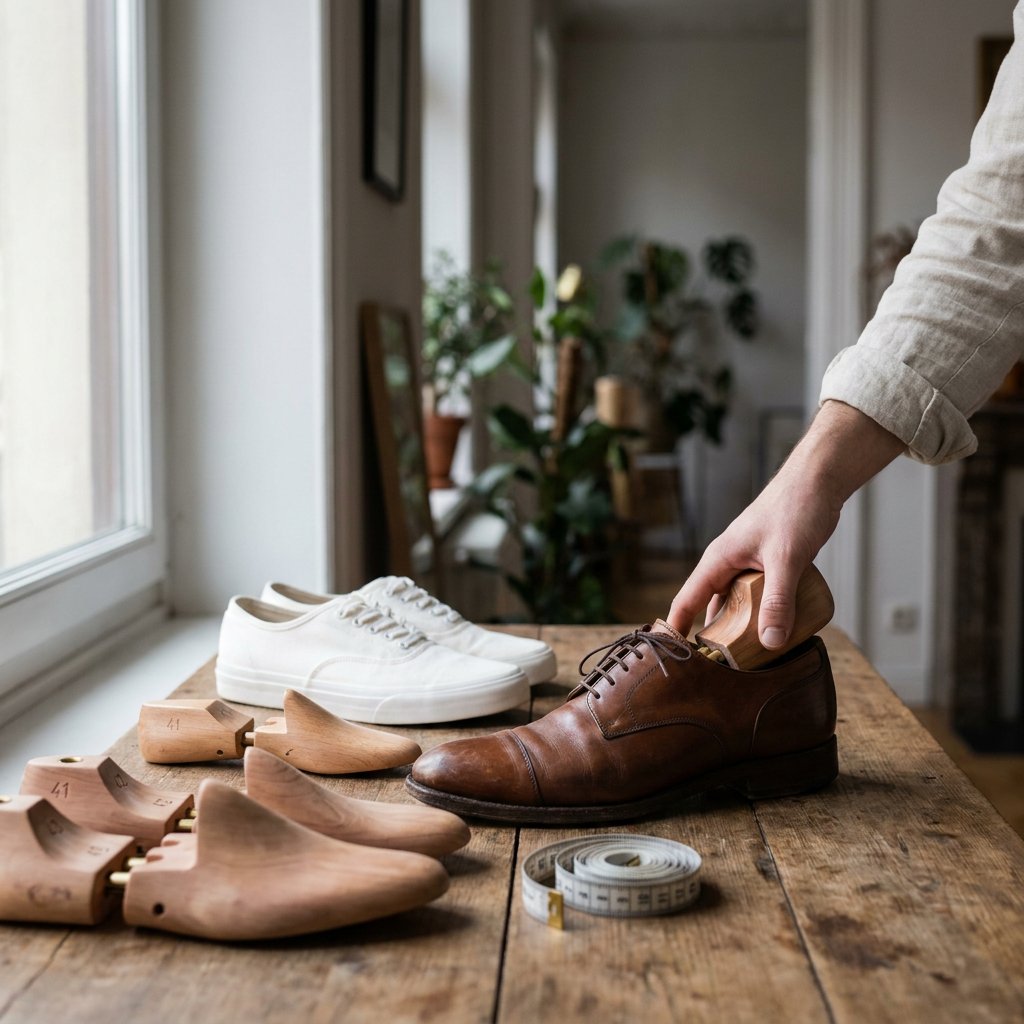

The right size shoe trees prevent your shoes from stretching unnecessarily or getting too little support. In most cases, you choose shoe trees based on your shoe size, but the right answer also depends on the type of shoe. For leather shoes, your regular size or half a size up usually works best. For sneakers, going one size down is often recommended instead, so the tension is not too strong. Pay particular attention to length, not just width. A well-fitting shoe tree helps your shoes keep their shape, absorb moisture, and reduce creasing.
Explore Our Collection
Shop Now →What size shoe tree fits your shoes best?
As a rule of thumb, a shoe tree should fit snugly without putting the shoe under visible tension. It should fill out the shoe, but not force it. That matters, because shoe trees that are too large can stretch the upper unnecessarily, while shoe trees that are too small do too little to help the shoe hold its shape.
For classic leather shoes, you can usually go with your normal shoe size. If you wear a half size, rounding up is often the safest choice. Sneakers are different. Because sneakers are often softer and roomier than dress leather shoes, a shoe tree one size smaller often works better. That keeps the shape neat without putting too much pressure on the toe box or side panels.
Not sure between two sizes? Don’t just look at the size label inside the shoe, but also at the fit of that specific pair. A narrow model, a long toe, or a compact-fitting sneaker can mean the same shoe tree size fits perfectly in one pair and feels too tight in another.
Should you choose shoe trees a size bigger or smaller?
The question of whether to size up or down in shoe trees does not have one fully universal answer. For most shoes, slightly smaller is better than too large, as long as the shoe tree still provides enough tension to support the shape.
- For leather lace-up shoes: usually your own size
- For half sizes: often round up
- For sneakers: often one size smaller
- If in doubt: choose the size that does not force the length
A larger shoe tree can seem logical because you may think more tension works better. In practice, too much tension leads more quickly to distortion, extra pressure on seams, and unnecessary stretching of the material. That is especially something to avoid with sneakers. More tips? Prevent creases in your sneakers.
What should you look for when choosing the right size?
Length matters more than width
When deciding what size shoe trees you need, length is usually the deciding factor. Many shoe trees have some flexibility or spread at the front, so width is less often the main issue. Length determines whether the heel and toe are properly supported.
Dual sizing is less precise
Shoe trees in dual sizes, such as 42-43 or 44-45, are less precise than models with single sizing. That does not have to be a problem, but the chance of a less secure fit is greater. If you are right at the beginning or end of such a size range, the shoe tree may be slightly too loose or just too tight.
The type of shoe makes a difference
Not every shoe needs the same size choice. Leather loafers, dress shoes, and smart lace-up shoes often benefit from a precise fit. Sneakers are usually more forgiving, but should not be stretched too tightly. If you mainly use a shoe tree to keep sneakers in shape while drying without damage or while storing them, slightly less tension is often better.
Size chart as a quick guideline
| Shoe type | Recommended shoe tree size | Note |
|---|---|---|
| Classic leather shoes | Your own size | Usually gives the best balance between support and tension |
| Leather shoes in half sizes | Round half sizes up | Prevents a loose fit |
| Sneakers | Often one size smaller | Limits unnecessary pressure on the upper |
| Between two sizes | Choose the less tight option | Only if the shoe is still properly supported |
Why the right shoe tree size matters
A well-fitting shoe tree does more than just fill the front of your shoe. It helps the shoe keep its shape after wear, especially when the material is still warm and slightly damp. That is when shoes are most vulnerable to creasing and losing their shape.
With wooden shoe trees, there is also a practical extra benefit: wood can absorb moisture. That helps especially with shoes you wear for long periods or that feel slightly damp inside after use. For sneaker lovers, a shoe tree can therefore be a useful addition when drying and neatly storing your pair. If you are also more broadly focused on sneaker care, this extra support can be helpful too.
Size remains crucial here. Only a shoe tree that fits well supports the shoe the way it is meant to. Too much pressure works against you, while too little pressure has hardly any effect.
How long should you use shoe trees?
Ideally, you should use shoe trees as soon as you take your shoes off, especially if you wore them that day. Then leave them in the shoes for as long as you are not wearing the pair. That could be one night, a few days, or longer during storage. The most important thing is that the shoe can gradually return to its original shape.
If you wear your shoes regularly, consistent use is more useful than occasional use. Especially with leather shoes and neat sneakers, it helps limit creasing and keeps the shape looking sharper for longer.
Are shoe trees necessary?
Shoe trees are not essential for everyone, but they are useful if you want to keep your shoes looking good. They are especially valuable for leather shoes, premium sneakers, and pairs you like to keep in neat condition. If you do not use them, your shoes will not become unusable right away, but the risk of creasing, shape loss, and a less polished look does increase. For sneakers, you can also use anti-crease shields as an easy alternative to help the toe box keep its shape.
Common mistakes when choosing shoe tree sizes
- Choosing one size bigger in the hope of better results
- Only looking at width and forgetting about length
- Using the same tension for sneakers as for leather shoes
- Choosing a dual size without checking the actual fit of the pair
- Forcing the shoe tree in when it is clearly too tight
FAQ about what size shoe trees to choose
What size shoe tree do I need?
For leather shoes, you usually choose your own shoe size. For sneakers, one size smaller often works better. Always check that the shoe tree fits properly without stretching the shoe.
Should you choose shoe trees a size bigger or smaller?
In most cases, not bigger. For sneakers, often smaller; for leather shoes, usually the same as your own size. Too large creates too much tension on the material more quickly.
Are shoe trees necessary for sneakers?
Not necessarily, but they are handy if you want to keep your sneakers looking nicely shaped. Especially after wearing or drying them, a well-fitting shoe tree can help.
How long should shoe trees stay in your shoes?
At least until the shoe has fully cooled down and dried after wearing. If you leave a pair stored for longer, you can simply keep the shoe trees in. For longer-term storage, it is also helpful to know whether to store sneakers in a box or on display.
What if I am between two sizes?
Choose the size that supports the shoe without forcing it. With leather shoes, you can often round up, while with sneakers you can be a bit more cautious. If you store your pair neatly afterward, sneaker storage boxes can also help.
This article was written by Marijn van der Heijden.
Tip

Laat een reactie achter
Deze site wordt beschermd door hCaptcha en het privacybeleid en de servicevoorwaarden van hCaptcha zijn van toepassing.