




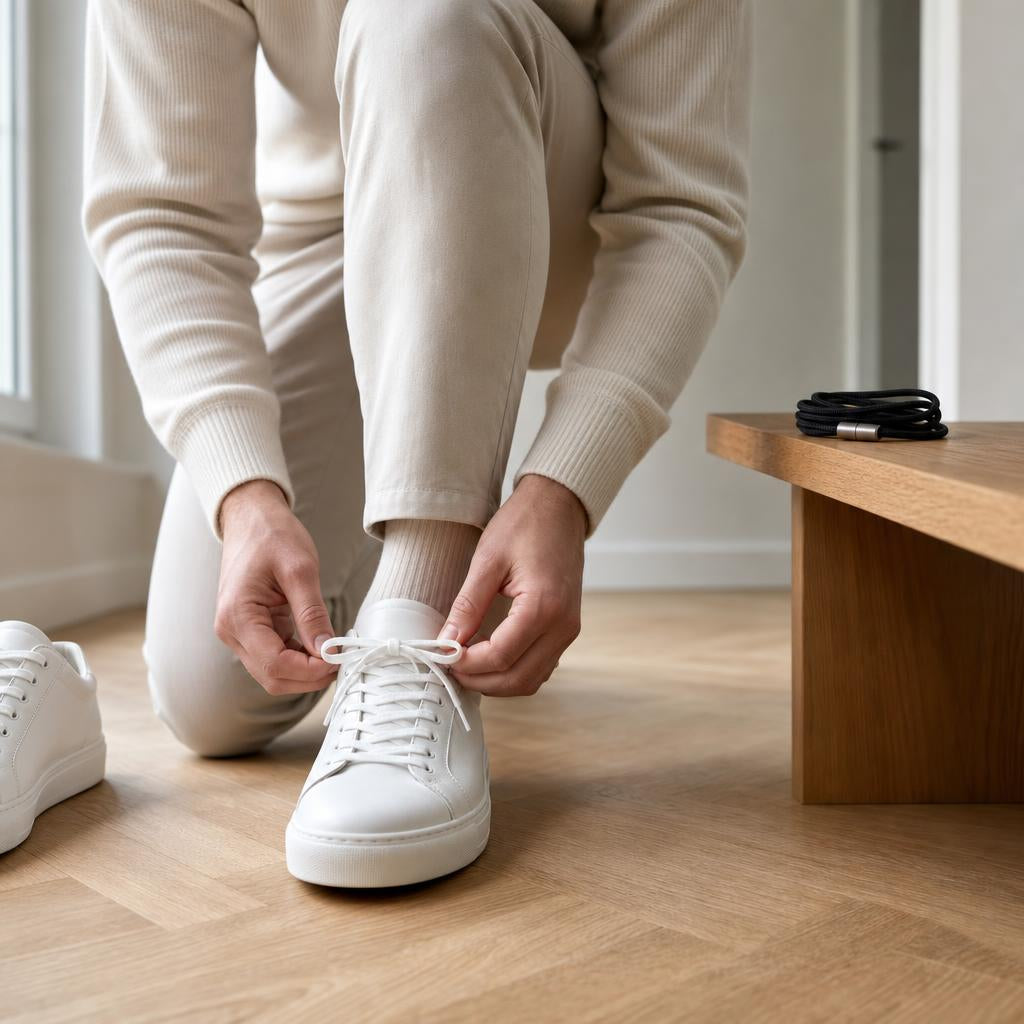
Tying shoelaces does not have to be difficult. Whether you want to learn how to tie laces, lace your sneakers more neatly, or are looking for no-tie laces, the right technique helps your shoes fit better and look cleaner. On this page, you will discover how to tie your laces, which lacing methods exist, and when elastic laces or no-tie laces are smarter than a classic bow.
Ontdek de nieuwste sneaker drops
Shop collectie →How can you tie shoelaces easily?
The easiest way to tie shoelaces is the standard bow with two loops, also known as the bunny ears method. It is quick, logical, and works well for most sneakers and shoes. Always follow the same order: first even out the laces, make a half knot, form two loops, and pull them through each other. Then tighten both loops at the same time so the bow stays secure.
If your shoelaces keep coming undone, the problem is often not just the knot but also the lace type. Smooth round laces slip open faster than flat sneaker laces. For everyday wear, many people therefore choose flat or slightly grippier shoelaces. If you want to tie your laces quickly, make sure the length is right too. Laces that are too long look messy, while laces that are too short are hard to grab.
Learn to tie shoelaces step by step
If you want to learn how to tie shoelaces or teach children how to tie them, a fixed method works best. Keep it simple and repeat the same movements every time. That helps you build routine quickly.
The standard two-loop method
- Grab both ends of the shoelaces.
- Pull the laces even so the left and right sides are about the same length.
- Cross the laces over each other.
- Pull one lace under the other and tighten to make a half knot.
- Make a loop with both sides.
- Cross the loops over each other.
- Pull one loop under the other.
- Tighten both loops firmly at the same time.
Easy shoelace tying with the bunny ears method
For beginners, this is often the easiest way to tie shoelaces. After the half knot, you immediately make two loops, like bunny ears. Then you tie those two loops together. This method is clear and easy to follow because you keep working with the same shapes and are less likely to get confused than with a single-loop technique.
Practising how to tie shoelaces
Practising works best with flat laces, laces that are not too slippery, and a shoe that stands firmly on a table. For children, a practice shoe can help, but practising on a real sneaker is ultimately the most useful. Say each step out loud: cross, pull through, make a loop, tighten. That way, tying laces quickly becomes a fixed routine.
Ways to tie laces on sneakers
Are you looking for ways to tie your laces that are not only practical but also fit your look better? Then there are several sneaker lacing methods to choose from. Some techniques are mainly about style, while others focus on comfort or convenience. Especially with popular models such as Nike, Adidas, New Balance, Vans, or Air Force 1, it often comes down to how tight, loose, or visible you want the laces to be.
Standard criss-cross lacing
This is the most commonly used method for tying shoes. The laces run in a criss-cross pattern from bottom to top and distribute tension quite evenly across the shoe. For most low-top sneakers, this is the safest and simplest choice. If you just want neat shoes or want to tie sports shoes without hassle, this method works well.
Straight bar lacing
Straight or horizontal lacing gives a clean, streamlined look. You often see this method on minimalist sneakers and smart casual shoes. The horizontal lines stand out, and the eyelets look calmer than with crossed laces. It is a popular choice for anyone who wants neatly tied laces without busy crossing on top of the shoe.
Hidden lace tying
With sneakers, many people choose to hide the bow behind the tongue or inside the shoe. Tucking the laces behind the tongue creates a clean look, especially on models worn a bit looser. Just make sure the shoe does not become too loose. This works particularly well on lifestyle sneakers and less well on shoes that need a lot of support.
Loose sneaker style without a visible bow
Tying sneakers without a visible bow is popular for models such as Nike Air Force 1, Jordan 1, Air Max, Adidas Superstar, Converse, and Vans. The laces are threaded so the shoe sits nicely without showing a classic bow at the top. In practice, this often means lacing a little looser, tucking away the ends, or choosing laces you do not have to tie.
Which lace technique fits your goal?
| Goal | Best approach | Why |
|---|---|---|
| Quick and easy | Standard bow with flat laces | Easy to learn and secure enough for everyday use |
| Clean sneaker look | Straight bar lacing | Calm, clean appearance on sneakers |
| No visible bow | Hidden tying or tucking away the ends | Popular in sneaker styling |
| Never tie laces again | Elastic no-tie laces | Easy slip-on wear and no loose bow anymore |
| Secure while moving | Tighten well and use a double knot | Less chance of laces coming undone |
No-tie laces - when is that smarter?
Not everyone wants to tie classic shoelaces. Sometimes you just want convenience, speed, or a cleaner sneaker look. In that case, no-tie laces are a logical choice. Think of elastic no-tie laces, no-tie systems, or shoelaces with a metal lock or toggle. With those, you set the tension properly once and then step in and out of your shoes easily.
For anyone who wears sneakers often, plays sports, wants to switch quickly on the go, or simply does not want to tie laces anymore, this is a practical solution. Children often find this easier than learning how to tie laces themselves too. The big advantage is clear: no more tying, less chance of loose laces, and a tidy look without dangling ends.
Benefits of elastic no-tie laces
- Easy to put on and take off
- No loose bow while walking or exercising
- Comfortable tension across the foot
- Useful for sneakers, trainers, and casual shoes
- Ideal if you do not want to tie laces anymore
Which shoes does this work well for?
No-tie laces work especially well on sneakers such as Air Force 1, Air Max, Adidas sneakers, New Balance, Vans, and other casual models. They are also popular on both high-tops and low-tops. For very formal shoes, most people still choose a classic bow, but for everyday sneakers, a no-tie system is often the easiest upgrade.
Why do shoelaces keep coming undone?
If your shoelaces keep coming undone, there can be several reasons. Often, the knot is not tightened symmetrically enough, you are using smooth round laces, or the laces are too long. It may also be that you make the half knot in the wrong direction, causing the final bow to sit unevenly and come loose faster.
If you want tightly tied laces that stay in place better, pay attention to these points:
- Use flat or grippier laces if your current laces are too slippery.
- Tighten the base of the half knot properly first.
- Make sure the loops are the same size.
- Use a double knot for extra security.
- Choose the right lace length so you do not end up with overly long ends.
The right lace length makes tying easier
Many lace-tying problems start with the wrong length. Laces that are too long create big loops, loose ends, and a messy look. Laces that are too short make it difficult to make a proper bow. For sneakers, the ideal length depends on the number of eyelets, but also on how you wear the shoe: tight, loose, straight laced, or with a hidden bow.
At Hypedpair, you can find sneaker laces in 100, 120, 140, 160, and 180 cm, among others. That makes it easier to match your laces to your model and style. Especially if different lacing methods matter to you, the right shoelace length per sneaker is just as important as the technique itself.
Tying laces for popular sneakers
Searches such as nike laces tying, adidas laces tying, air force 1 laces tying, jordan 1 laces tying, or vans laces tying mainly show one thing: people want a look that matches their sneaker. The basics usually stay the same, but the finish differs by model.
- Air Force 1 laces - often worn a little looser, with a neat top and sometimes without a visible bow.
- Air Max laces - usually comfortable and not too tight, so the shoe keeps a sporty look.
- Jordan 1 laces - popular with looser styling, especially on high and mid models.
- Adidas sneaker laces - often clean and symmetrical, especially on models with a minimalist upper.
- Converse or Vans laces - often classic criss-cross or a little looser for a casual look.
If style matters most to you, you can choose wide laces, rope laces, fluffy laces, or reflective laces. Those do not just change how your sneakers look when laced, but also the overall feel of your pair.
When should you choose different laces?
Sometimes you do not need to change your technique, only your laces. Flat sneaker laces usually create a cleaner look and often stay in place better. Round or rope laces fit well with a more eye-catching style. Wide laces add more presence to sneakers with a broad tongue, while reflective or fluffy versions are meant to personalise your pair.
If convenience is your main goal, new laces are often the best step. View all laces. If you want to lace classic shoes with more grip, choose a lace that is less slippery. The right lace makes easy lace tying a lot simpler.
FAQ about tying shoelaces
What is the easiest way to tie shoelaces?
The easiest method is the standard two-loop bow. Cross the laces, make a half knot, form two loops, and pull them through each other. This method is clear, quick to learn, and suitable for almost all sneakers.
How do you teach children to tie shoelaces?
Use a fixed order and simple words. The bunny ears method often works best. Practise briefly but regularly and choose flat laces that are not too slippery. That makes learning to tie laces much easier.
At what age do children usually learn to tie shoelaces?
This varies from child to child, but many children learn sometime between ages 5 and 7. Motor skills, patience, and practice all play a big role. So it is more normal than you think if it takes a little longer.
How do I cross shoelaces correctly?
First, pull both ends to equal length. Then place the left lace over the right, or the other way around, and pull one end under the other. That forms the basis for both the half knot and almost all classic ways of tying shoelaces.
What are good laces for sneakers without tying?
Elastic no-tie laces are the best option for this. You set the tension once and then use a lock or fastening to secure the lace. That way, you can wear your sneakers without having to tie them again each time.
Why are flat laces often easier than round laces?
Flat laces have more grip and slip loose less quickly. Because of that, they usually stay tied better and are more comfortable for anyone who wants to tie laces quickly or easily.
How do I stop my shoelaces from being too long?
Choose a lace length that matches the number of eyelets and how you wear your shoes. With a hidden bow or loose styling, you can sometimes go a little shorter than with classically tied sneakers with big loops.
Which is better: tying laces or no-tie laces?
That depends on your goal. Tying classic shoelaces is flexible and suits almost every shoe. Laces you do not have to tie are more practical if speed, comfort, and convenience matter more to you than a traditional bow.
This article was written by Marijn van der Heijden.
★★★★★ 4.9/5 uit 400+ reviews
Scoor jouw volgende exclusive pair
Geverifieerd op echtheid, scherpe prijzen en snel verzonden. Ontdek de meest gewilde sneakers van dit moment.
Shop sneakers

Leave a comment
This site is protected by hCaptcha and the hCaptcha Privacy Policy and Terms of Service apply.