




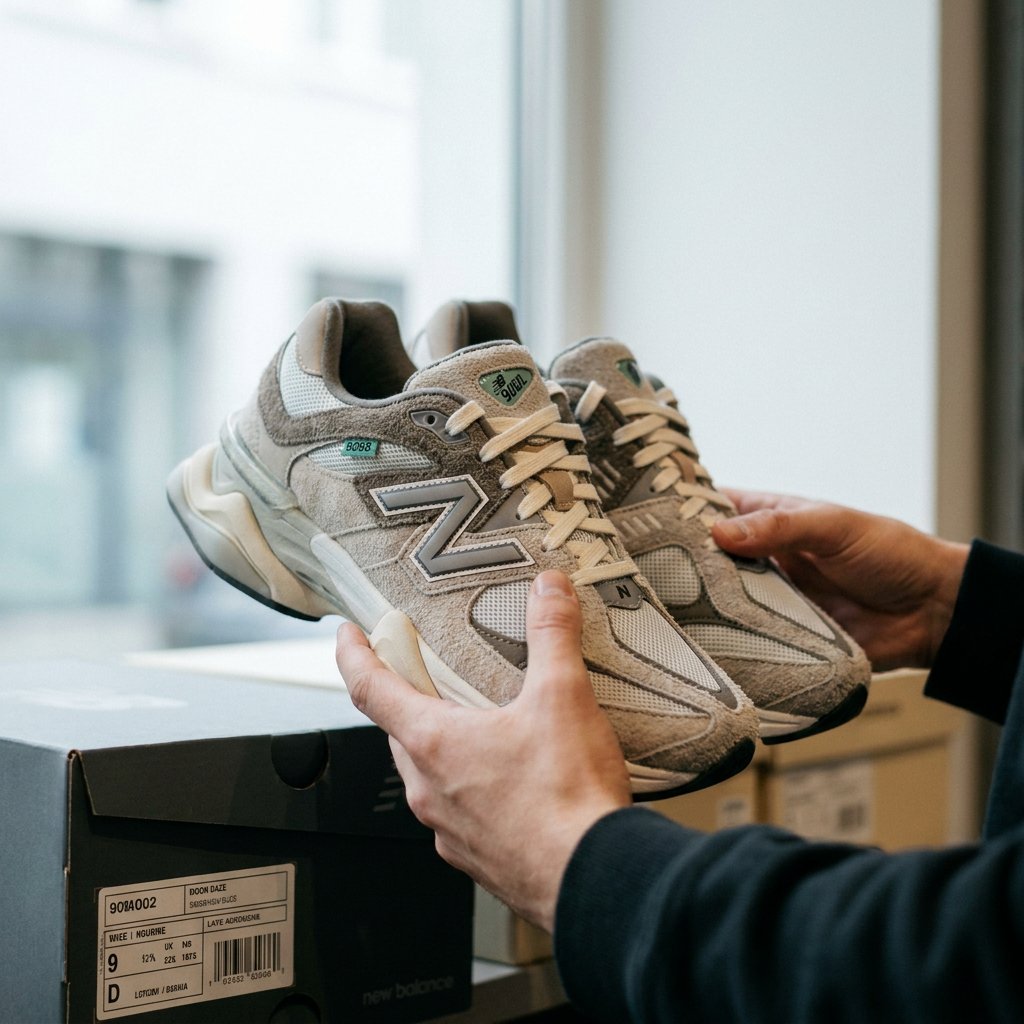
Spotting real New Balance starts with checking a few fixed details. Think of the N logo, the tongue label, the product code, the stitch finishing, and the quality of the suede, mesh, or leather. Especially with popular models like the New Balance 9060, 530, 550, and 574, it is smart not to rely on one feature alone, but to combine multiple checks. That makes it easier to see the difference between an original pair and a replica.
Not sure whether your pair is real, or want to buy safely? With the checkpoints below, you can verify New Balance shoes in a practical way, without unnecessary detours.
Explore Our Collection
Shop Now →What should you check first on real New Balance sneakers?
The fastest first check is always the overall impression of the shoe. A real New Balance usually looks balanced right away: the shape is correct, materials connect neatly, and details feel intentionally finished. Fakes often stand out because of small deviations that together create a messy impression.
- The logo sits straight and has clean proportions.
- The model has a consistent shape, especially around the toe, heel, and sole.
- Stitching runs tight and symmetrically.
- Labels show logical sizing information and a matching product code.
- The box and the shoe itself match in model and color.
If you notice small mistakes in several places, that is often a stronger signal than one detail on its own.
Checking the N logo
The N logo is one of New Balance's most recognizable features, so it is also a detail where counterfeit makers often get it wrong. On an original pair, the logo is cleanly finished, neatly placed, and proportional to the rest of the upper. The edges should be clean, and the shape should look consistent with official product photos of the same model.
On fakes, you often see a logo that is too thick or too narrow, placed crookedly, or finished sloppily around the edges. Color differences also stand out: the logo may be slightly too light, too dark, or too glossy compared to the original. Always check both shoes, because asymmetry between left and right is a clear warning sign.
Checking the tongue label, size label, and product code
If you want to know how to verify New Balance shoes, you should always inspect the labels. The tongue label or inner label normally shows the size, country codes, and a product code that matches the model. That code should make sense and match the shoebox.
On a real New Balance pair, the label layout is neatly printed and easy to read. Text sits straight, letters are sharp, and there should be no spelling mistakes. On fakes, you regularly see blurry print, different fonts, or codes that do not match the model in front of you. Compare design and label details of commonly confused models with the New Balance 2002R vs 1906R comparison.
Pay extra attention to the product code on the New Balance 9060
On the New Balance 9060, the product code is an important checkpoint. HypedPair also mentions this as one of its standard authenticity checks. Make sure the code on the label matches the code on the box. On the 9060, the product code often starts with U9060, followed by letters referring to the colorway. If that does not match, further checking is wise.
Stitching, finishing, and the shoe's shape
How can you tell if sneakers are real? Take a close look at the finishing. Real New Balance sneakers usually have tight, short, and even stitching. Loose threads, crooked lines, or major differences between the left and right shoe do not fit a clean finish.
The shape of the shoe also says a lot. Popular models have a recognizable silhouette. A fake pair often looks slightly too bulky, too angular, or too soft. The toe shape, heel section, and transition between upper and sole are especially good areas to inspect. If in doubt, compare the shoe with official photos of that exact release, not just a general image of the model.
Feel and inspect the materials
New Balance uses combinations of suede, mesh, leather, nubuck, and rubber on many popular models. On an original pair, those materials usually feel sturdy, even, and well cared for. Suede, for example, should have a clear texture without a plastic-like shine. Mesh should sit tight and not feel cheap or limp.
On fakes, the materials are often one of the fastest giveaways. The suede may be too smooth, the leather too stiff or artificially soft, and the shoe may feel lighter than expected. The lining and insole also often provide clues: on an original pair, they fit more neatly and feel less cheap.
Check the inside of the shoe
Many people only look at the outside, but the inside often reveals just as much. Check whether the insole is placed neatly, whether the print on it is sharp, and whether the interior finishing looks clean. Excess glue residue, sloppy foam, or a loose-feeling insole are signs to stay alert.
You do not have to take every pair apart, but a quick inside check really helps. Especially when the outside looks fairly convincing, hidden details can clearly show the difference between real and fake.
Compare the shoebox, barcode, and packaging
An original New Balance box should match the pair inside. The box label should show the correct model, correct size, and a matching product code. The print should be sharp, and the barcode should not look blurry or amateurish.
Also check whether the color name makes sense and whether the box and shoes match exactly. On fakes, you often see generic boxes, mislabeled sizes, or a convincing shoe paired with sloppy packaging. That last case often happens with pairs sold online through resale platforms.
How do I spot fake New Balance 530, 550, 574, and 9060?
The basic checks stay the same, but with popular models it pays to be extra sharp because those are the ones most often copied.
New Balance 530
On the 530, pay attention to the sporty shape, the mesh, the panels, and the placement of the logo. Fakes here often have rougher finishing and a less refined sole shape. If you want to verify offered color codes and colorways, check out the New Balance 530 colorways: popular colors.
New Balance 550
On the 550, fake pairs often give themselves away through the leather upper, the perforations, and the panel proportions. The model should look compact and sturdy, not bulky or limp.
New Balance 574
On the 574, material transitions matter most. Suede and mesh should come together neatly, and the shoe should have a balanced classic silhouette.
New Balance 9060
On the 9060, a lot comes down to the product code, the layered upper, the sole shape, and the material finishing. Because this model has striking lines and multiple panels, small errors in shape or finishing stand out faster. Check especially carefully whether the label, box, and colorway all match completely.
Where are real New Balance made?
A common question is where real New Balance are made. The short answer: original New Balance sneakers can come from different countries, depending on the model and production line. So you cannot simply say a pair is fake because it does not come from one specific country.
What matters more is that the information on the label looks logical, neat, and consistent. A suspicious label with odd formatting, illogical combinations, or mistakes in country information is more relevant than the country itself. For more background on production lines, you can also read Made in USA vs Made in UK: differences in New Balance.
What if a pair has a QR code?
Some sneakers or packaging include a QR code or digital reference, but treat that mainly as an extra check. A working code can help, but a code alone does not automatically prove that a pair is real. The reverse is also true: not every original pair necessarily has the same digital verification.
So never use a QR code as your only proof. Always combine it with checks of the product code, finishing, material, and packaging.
Practical checklist to spot real New Balance
- Check whether the N logo is clean, straight, and symmetrical.
- Compare the tongue label and inner label for size, layout, and product code.
- Check whether the product code on the shoe matches the box.
- Inspect stitching on the toe, side panels, heel, and tongue.
- Feel whether the suede, mesh, or leather matches the expected quality.
- Compare the shoe's shape with official product photos.
- Inspect the insole and interior for clean finishing.
- Check the box, barcode, and color name.
- Be extra critical of unusually low prices.
Not sure whether your New Balance is real?
Doubt is often a sign that something is not quite right. Compare your pair step by step with official product photos of the exact same model and colorway. Do not only look at the outside, but also at the labels, box, and material texture. The more parts that differ, the greater the chance you are dealing with a fake.
If you mainly want to buy safely, it helps to choose a seller that actively checks authenticity. HypedPair says it verifies every pair and checks the box, labels, shape, materials, and overall finishing. Especially with sought-after models like the New Balance 9060, that can provide extra peace of mind. If you want to browse models right away afterward, you can visit the New Balance collection.
Frequently asked questions about spotting real New Balance
How can I verify New Balance shoes?
You can verify New Balance shoes by combining several points: logo, labels, product code, stitching, materials, shape, and box. It is better not to rely on one detail, but on the overall picture. If you are unsure about size or fit while comparing, also check the size chart and fit guide.
How do you know if sneakers are real?
Real sneakers usually have neat finishing, accurate labels, consistent materials, and packaging that matches the model. Fakes often reveal themselves through small mistakes in multiple places.
How do I spot fake New Balance 530?
On the New Balance 530, pay close attention to the shape, the quality of the mesh, the logo, and the sole finishing. A fake pair often looks less clean and feels cheaper.
Where are real New Balance made?
Real New Balance sneakers are produced in different countries depending on the model and line. So the country of production alone does not say enough. The consistency of the label and product information matters more.
Is a low price a sign of a fake?
Not always, but a price that sits far below market value is a clear warning sign. Especially on popular releases, extremely cheap offers are a reason to check more critically.
What is the most important checkpoint on a New Balance 9060?
On the 9060, the product code, the shape of the sole, the material finishing, and the match between the shoe and the box are important checkpoints. The code on the label and the box should match logically. If you want to learn to recognize details of iconic models more often, the New Balance 990 line: fit and differences is also relevant.
This article was written by Marijn van der Heijden.

Leave a comment
This site is protected by hCaptcha and the hCaptcha Privacy Policy and Terms of Service apply.