



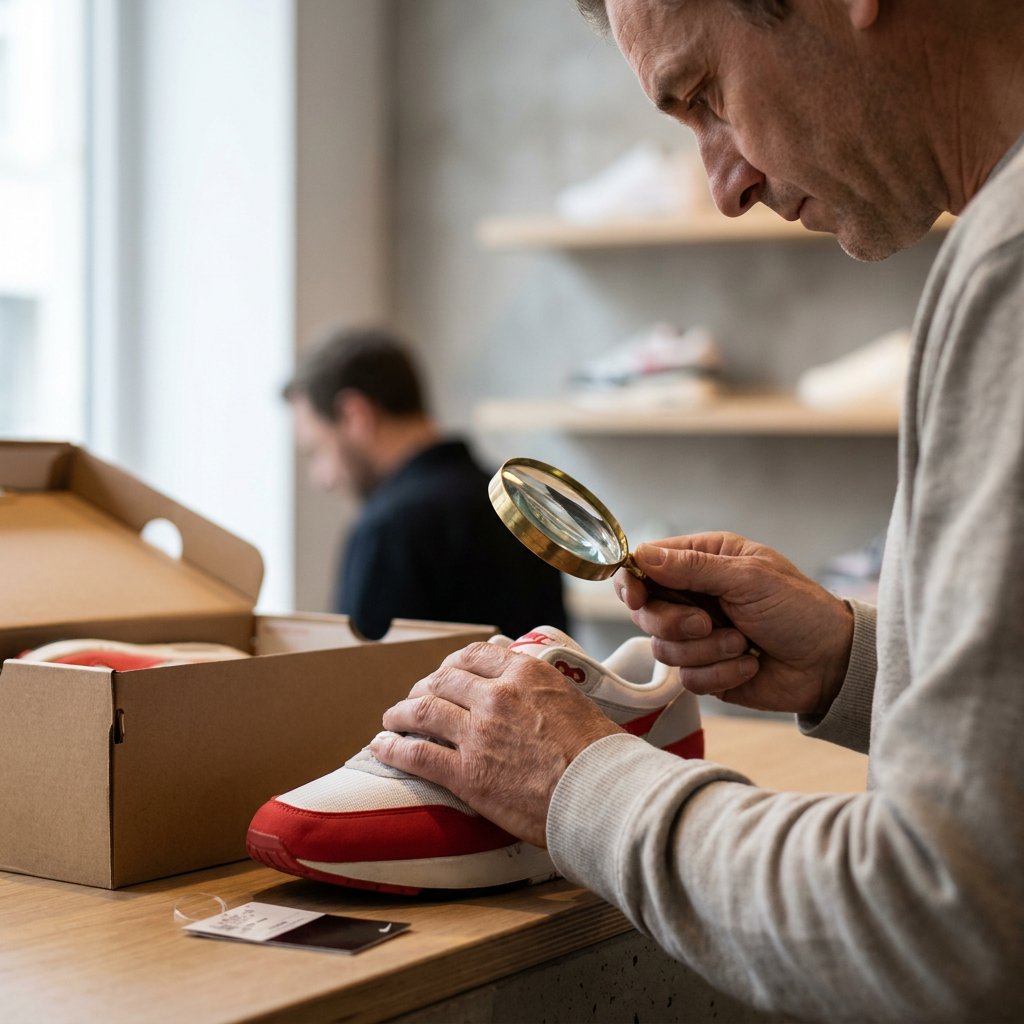
Fake Nike Air Max are getting harder to spot every year. That’s exactly why it’s smart not to rely on just one detail. If you want to know how to spot fake Nike Air Max, you need to look at the full picture: the seller, the price, the product code, the finishing, the Air unit, and the box. The checks below will help you see much faster whether a pair is likely authentic or whether you need to be extra careful.
Explore Our Collection
Shop Now →Never rely on one “magic” authenticity feature
A common mistake is thinking that one difference immediately proves a pair is fake, or that one correct detail automatically means everything is right. That’s not how it works with Nike Air Max. Production can vary slightly by factory, release year, and colorway. Special collaborations or limited releases can also have details that differ from standard models.
The best approach is simple: combine multiple signals. Do you see an unrealistically low price, a strange size label, a weak shape, and an Air unit that looks dull? Then the red flags start stacking up. If everything matches official product photos and product codes neatly, the chance increases that you’re dealing with a real pair.
Check the seller and the price first
Before zooming in on stitching and labels, start with the source. You can prevent a lot of problems by looking critically at the sales channel. Caution is especially important on marketplaces, social media, and private sales.
- Is the price much lower than usual without a clear reason?
- Is the seller only using stock photos or vague images?
- Are business details, return terms, or customer service missing?
- Is only an unsafe payment method offered?
- Is the shipping time unusually long even though the pair is supposedly in stock?
A low price alone does not prove sneakers are fake, but if a sought-after Air Max pair is listed far below market value, that is a strong warning sign. When in doubt, use a payment method with buyer protection and always ask for extra photos of the exact pair you’re buying.
Always ask for clear photos of the actual pair
If you’re buying online, you do not want general product photos but images of the actual shoes. Ask for sharp photos of the left side, right side, top, heel, tongue, inner label, insole, and box label. Also ask for a photo with the seller’s name and date. That lowers the chance that someone is using random images from the internet.
Then compare those images with official product photos or reliable references of the exact same model and colorway. Do not only look at color, but also at shape, material texture, panel placement, and the proportions of the Swoosh.
Check the box and the box label
The shoebox is not waterproof proof, but it is often a good first check. Fake Nike Air Max are regularly delivered in a box with the wrong shade, weak print quality, or a label that does not match.
- Check whether the label on the box shows the correct size, color, and product code.
- Compare the font, alignment, and print quality with known authentic examples.
- Check whether the product code makes sense for the model.
- Watch out for damaged, extremely thin, or generic boxes on a pair sold as new.
Keep exceptions in mind. A replacement box or a damaged original box does happen, especially on the resale market. That’s why you should always use the box together with other checks.
Compare the product code on the box and the shoe
If you’re wondering how to tell whether Nike Air Max are real, you should almost always start with the product code. With Nike, you often see a SKU in a format like AA1234-567. That code should logically match the model, the colorway, and the information on the box.
So check three things:
- Does the code on the box label match the code on the label inside the shoe?
- Does that code exist online in combination with the exact same colorway?
- Does the label layout look clean and correct, without strange spacing, typos, or crooked print?
A code that brings up nothing online, or shows a different model, is suspicious. Still, be careful: older releases, re-releases, or production years can sometimes get mixed up. So here too, the rule remains the same: combine multiple signals.
Pay attention to shape, Swoosh, and overall finishing
A lot of fakes look convincing from a distance, but fall short in proportions and finishing. With Nike Air Max in particular, the shape and placement of details are important signals.
Swoosh placement
The Swoosh should sit neatly in proportion to the model’s panels. On fakes, it is sometimes too low, too large, too thick, or slightly bent the wrong way. Always compare with official photos of the exact same release.
Stitching and seams
Look at whether the stitches are consistent and whether lines run neatly. Loose threads, sloppy curves, and inaccurate panel edges can point to fakes. Small imperfections also happen on authentic production pairs, so this is most useful when it appears together with other differences.
Heel and toe shape
On fake Air Max, you regularly see a toe box that is too bulbous, a mudguard that sits too low, or a heel that looks too soft. The shape of the sneaker should match the model. For example, read more about the difference between Air Max 1 and Air Max 90; each variation has its own silhouette, so always compare by model.
Check the materials and color finishing
One of the best ways to recognize fake Nike Air Max is to examine the materials critically. On authentic pairs, suede usually feels more alive, mesh textures are more consistent, and leather panels look less plastic-like. On fake sneakers, colors also often differ slightly: too dull, too saturated, or simply not the same as the official colorway.
So zoom in on:
- the texture of suede, mesh, or leather;
- the transition between materials;
- the accuracy of color blocking;
- reflective or special materials on collabs and premium releases.
Especially on sought-after versions with unique details, replicas usually give themselves away somewhere. Think of the wrong material on the mudguard, an unusual shine, or a texture that simply looks too flat.
Inspect the Air unit, midsole, and outsole
On Air Max models, the Air unit is an important checkpoint. It should be symmetrical, clear, and firmly placed. A dull, crooked, or messily finished unit is suspicious. An air bubble that looks loose or does not sit neatly in the midsole can also be a sign.
Also look at the midsole and outsole:
- are the cutouts and lines neatly finished;
- does the outsole pattern match original references;
- does the rubber look solid rather than cheap or shiny;
- does the shape of the sole make sense for the model.
Because Nike Air Max are known for visible cushioning, flaws here often stand out faster than on other sneakers.
Don’t forget the tongue, insole, and inner label
The outside usually gets the most attention, but inside the shoe you can often find just as many valuable clues. How can I check if Nike shoes are real? By also checking the parts that counterfeiters sometimes handle less carefully.
Tongue and tongue label
Pay attention to the height of the tongue, its shape, and the finish of the label. A tongue that is noticeably short or a crooked, poorly printed Nike label can point to a fake.
Insole
Check the print on the insole and compare it with authentic examples. On replicas, the print is sometimes too rough, too glossy, or placed incorrectly. The quality of the foam can also feel different.
Inner label
The size label inside the shoe is an important check. Look at the font, spacing, alignment, product code, and overall print quality. Labels that look messy or do not match the box deserve extra attention.
Quick checklist: how to spot fake Nikes in a few minutes
- Price far below market value? Be extra alert.
- Unreliable seller or no buyer protection? Walk away.
- Box label and inner label do not match? Major red flag.
- Swoosh, shape, or mudguard does not match official photos? Suspicious.
- Air unit looks dull, crooked, or cheaply finished? Be careful.
- Materials feel or look unnatural? Keep checking.
- Too few real photos of the pair? Ask for them first.
What should you check more closely on each Nike Air Max model?
The basic checks stay the same, but every model has its own details. On an Air Max 1, people often look at the mudguard, toe box, Swoosh, and heel shape. On an Air Max 90, the sole shape, panel proportions, and Air unit stand out more quickly. That’s why it’s smart to always compare with official photos of that exact model and colorway.
What should you do if you think you bought fake Nike Air Max?
Stop assuming that it’s “probably fine” and gather evidence right away. Take sharp photos of the box, labels, Air unit, finishing, and any unusual details. Then contact the seller and explain clearly what does not match.
- Ask for a solution or a refund.
- Use buyer protection through your payment provider if needed.
- Save all communication and screenshots of the listing.
- Do not wear the pair extensively first, so your position is stronger if you file a claim.
If you prefer buying with more certainty, it makes sense to choose a seller that communicates clearly about authenticity, return options, and sneaker checks. At HypedPair, the focus is on 100% authentic, new, and unworn sneakers checked by experts. You can also browse the Nike Air Max collection to compare authentic models and details.
Has your pair been confirmed as authentic? Read how to clean Nike Air Max so you can clean them safely without damage.
Frequently asked questions about fake Nike Air Max
How can you tell if Nike Air Max are real?
You can tell whether Nike Air Max are real by checking multiple points at once: the seller, the price, the product code, the inner label, the Swoosh, the shape, the materials, the Air unit, and the box. One detail is never enough.
How do I spot fake Nikes?
You can often spot fake Nikes through a combination of incorrect labels, sloppy finishing, the wrong shape, cheap materials, and an unreliable sales channel. Always compare with official product photos of the same model. For broader tips, also read how to spot real Nike and Adidas sneakers.
How can I check if Nike shoes are authentic?
Check whether the product code on the shoe matches the box and can be found online with the correct colorway. Also look at whether the label is printed neatly and whether details like stitching, logo placement, and sole finishing are correct. If you also want to judge size labels and sizing, use a Nike sneaker size guide.
How can I recognize fake Nike Air Max?
Fake Nike Air Max can often be recognized by an unusual Air unit, the wrong toe or heel shape, inconsistent materials, and labels that do not match. A price that seems too good to be true also remains an important warning sign.
Is a different box immediate proof that a pair is fake?
No, not always. A box can be replaced or damaged. But if the box differs and the label, Air unit, or finishing also does not match, the chance of a fake becomes much higher.
Can authentic Nike Air Max have small imperfections?
Yes. Small finishing differences or minimal production tolerances do happen. That’s why it’s important not to judge a pair based on one imperfection, but to look at the total picture. For more background on original models, read the history of Nike Air Max.
This article was written by Marijn van der Heijden.


Leave a comment
This site is protected by hCaptcha and the hCaptcha Privacy Policy and Terms of Service apply.